Heaven
Awakening the Angel System: Apocalypse: A LitRPG Progression FantasyHeaven is both the greatest physical threat in the final campaign and one of the clearest symbols of the world’s transformation. It emerges as an ancient fortress hidden beneath a devastated continent, rises into the sky with the scale of a city, carries vast numbers of demonspawn, and nearly destroys the forces gathered against it. After its fall, however, the ruins are not abandoned. Five years later, what remains of Heaven has become the capital of the New Frontier, a place where resurrected people, explorers, workers, and councilors attempt to build ordinary civic life atop the remains of catastrophe.
Emergence and Scale
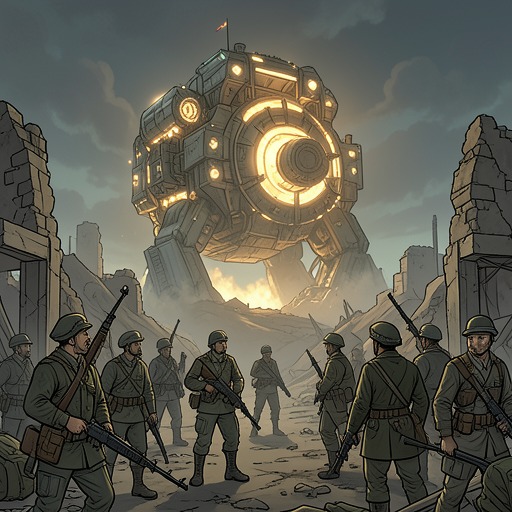
Heaven first appears when the battlefield itself begins to fail. The air vibrates, the earth shakes, and miasma and mana whirl together as the blood-soaked soil ruptures. From beneath it rises a massive structure that Jack Tanjihiro Chae-wong has never witnessed before. Sahaqiel identifies it with dismay as Heaven, making clear that the fortress is not merely arriving from a distant horizon but has been concealed beneath the land all along. Its emergence converts the landscape into an opening wound and changes the military situation immediately: the enemy’s stronghold is also a colossal mobile citadel.
The fortress’s scale is repeatedly presented through comparison. Hundreds of thousands, perhaps millions, of demonspawn fall from its edges as it climbs into the air. Its ancient bastion dwarfs even the Imperial capital, while massive thrusters lift the hidden structure above the continent. Heaven is therefore less a conventional building than a moving world, combining military power, demonic infestation, and an architecture old enough to appear caked with soil and rust. Its ascent makes the surrounding landscape almost irrelevant; the ground is torn apart, replaced by a gap in the earth and the fortress that had been buried beneath it.
Stronghold of the Final Conflict
Heaven is the setting for the last stage of Jack Tanjihiro Chae-wong’s advance. Its appearance interrupts the temporary exhilaration of the coalition forces, who have been using modern weapons against the Apostles. The air shudders, the ground opens, and the combatants discover that their victory on the surface has not reached the true center of the threat. Heaven’s rise thus functions as a reversal: the battlefield seems briefly manageable, then reveals an enemy structure of overwhelming scale.
The fortress also contains the most concentrated expression of Michael’s power. Within Heaven, Michael presents himself as possessing not one but two angels, treating the angelic beings as saviors and instruments under his command. When he waves his glowing hand, the wall behind his throne falls away and exposes a chamber filled with pulsating flesh and crystalline figures. The room appears as a sickness embedded in the fortress, an open wound from which anguish and pain seep into the world. A shackled, tanned-skinned man hangs suspended above a pit by chains and writhing tentacles, making the inner sanctum a physical record of captivity, experimentation, and corrupted transcendence.
Heaven’s defensive and offensive power reaches its climax during the battle above the ruined landscape. An air carrier rams the fortress after half of its engines have been destroyed. Heaven lists, loses control, and rotates as its propulsion fails. Sahaqiel notices that the air becomes easier to breathe, but the relief is inseparable from disaster: Jack cries out as the citadel crashes into the earth, releasing a shockwave that overwhelms his voice and spreads destruction across the battlefield.
Outer Sanctum and Ruined Interior
After the fall, Heaven becomes accessible as a physical ruin rather than an untouchable aerial bastion. Jack Tanjihiro Chae-wong reaches the castle entrance covered in demonic blood and looks into an abyss where multiple red eyes stare back at him. These demonspawn differ from those outside: they are more restrained, less rampant, and old. The entrance therefore marks a change in the nature of the threat. The outer battlefield contains mass violence and uncontrolled creatures, while the interior preserves older, more contained forms of danger.
Jack then enters Heaven’s outer sanctum, once a magnificent antechamber leading toward the inner sanctum. What remains is a ruin, but the ruin retains enough structure for him to imagine its former splendor. Beside the metal gate, he sees not only destruction but the memory of a haven and a home. The contrast gives Heaven an architectural history beyond its military function. It was built or experienced as a place of refuge before becoming a demonic fortress and battlefield, so its broken halls hold together sanctuary, imprisonment, and apocalypse.
The fortress also intersects with the book’s system-based language of power. Jack’s growth is rendered through visible status changes: the Authority of Gehenna rises from level two to level three, his Angel System reaches level ten with the title Nephilim and the abilities Regeneration++ and Mana Synthesis++, and an error warns of data corruption during the struggle involving Jill. Near Heaven’s interior, Jack unlocks a Radiant Skill and then an Anti-Army Class Skill in response to the need to save people on the brink of destruction. Heaven is consequently not just a location in which power is used; it is a pressure chamber where bodily injury, moral urgency, and game-like authorization converge.
Destruction and Transformation
Heaven’s fall destroys the form in which it first appears, but it does not erase the site’s importance. Its collapse is a military necessity and an emotional catastrophe. Jack’s scream carries rage, sorrow, and frustration, suggesting that the fortress’s destruction is measured not only by the loss of an enemy stronghold but by the people and hopes endangered around it. The citadel’s defeat opens the route toward the castle and its sanctums, yet the damage leaves behind a landscape that must later be cleaned, inhabited, and politically reorganized.
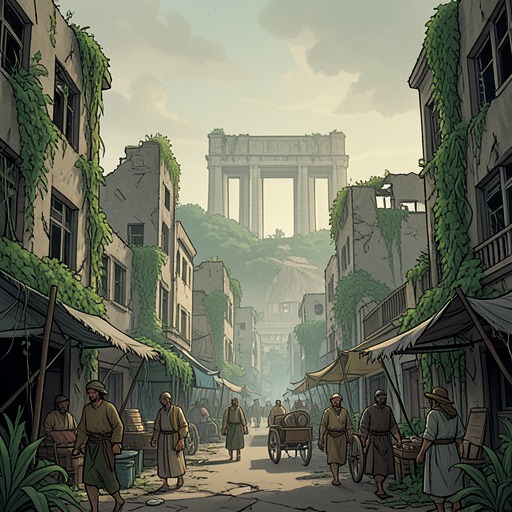
Five years later, Ada Nguyen arrives at a massive dig site associated with what remains of Heaven. The former bastion of the demonspawn has been transformed into the capital of the New Frontier because thousands of newly resurrected people need homes. Gold walls and marble pillars survive alongside wires and electric signs; former ruins become homes and shops. Banners of silver wings circle twelve chairs representing the Frontier’s council, and the site now hums with civilization rather than demonic infestation.
This redevelopment does not restore Heaven to its original condition. It overlays the old fortress with a new political and social purpose. The same architecture that once concealed demonspawn and housed Michael’s grotesque chamber now supports government, commerce, settlement, and exploration. Heaven becomes a forward base for explorers and thrill-seekers searching for lost treasures, so its ruin remains economically and symbolically active rather than becoming a sealed memorial.
Civic Afterlife and Narrative Significance
Heaven’s transformation parallels the wider rebuilding of the world after the battles and expeditions. At Jacksonville, the Bastion of the New Frontier, the shoreline becomes a public summer space where families and children play while fishermen use the piers. Against that ordinary coastal life, the converted fortress provides the institutional center of a sovereign frontier. The two locations together show how survival moves from emergency action to habitation: beaches become leisure spaces, and a former demonic bastion becomes a seat of government.
The final use of Heaven also extends the tension between autonomy and systems. In the ruins, Jack Tanjihiro Chae-wong later commands the Angel System to awaken before those gathered. Golden translucent interfaces appear, but his own interface is labeled Administrator, unlike the systems beside him. Selfia Cordelica recognizes the resemblance to the System and to abilities lost five years earlier. Heaven therefore becomes the stage for a new beginning in which the mechanisms that once defined combat and transformation may be redistributed or reactivated under Jack’s authority.
As a location, Heaven embodies a complete historical reversal. It begins below the earth as a concealed, ancient, contaminated stronghold; rises as a floating apocalypse; crashes as a source of shock and grief; and survives as a civic foundation. Its walls retain the memory of a haven, a demonic prison, and a battlefield, while its later inhabitants force those meanings into coexistence. The fortress’s decisive significance lies in that unresolved reuse: the future is not built on clean ground, but inside and above the ruins of the power that nearly ended the world.